


As demand for advanced skin resurfacing continues to rise, the comparison between CO2 lasers and Erbium:YAG lasers has become one of the most discussed topics in dermatology and medical aesthetics. Clinics, equipment distributors, and patients alike want to understand which technology delivers better texture improvement, especially for concerns like fine lines, enlarged pores, acne scars, and overall roughness of the skin.
Both laser systems have been used for decades, and both remain core technologies in professional resurfacing devices. But while their goals are similar, the mechanisms and treatment outcomes have key differences. To help clinics make informed investment decisions, this article provides a detailed comparison-covering technical principles, clinical applications, healing experience, and long-term results.
1. How the Two Technologies Work
CO2 Laser (10,600 nm)
A CO2 laser emits light absorbed strongly by water, creating controlled ablation and coagulation. Because human skin is water-rich, the 10,600 nm wavelength allows deep penetration and powerful thermal effects.
CO2 lasers create tiny microscopic columns (MTZs) that vaporize damaged tissue while heating surrounding structures. The thermal effect stimulates strong collagen remodeling, making CO2 lasers highly effective for:
Deep wrinkles
Acne scars
Texture irregularities
Loose or photo-damaged skin
Erbium:YAG Laser (2,940 nm)
Erbium lasers are also absorbed by water-much more strongly than CO2-but they generate less thermal coagulation. Their ablation is clean, sharp, and precise, making them preferred for:
Superficial fine lines
Mild texture issues
Delicate resurfacing
Patients seeking shorter downtime
Unlike CO2, Erbium:YAG lasers remove thin layers of skin with minimal heat spread, resulting in faster healing but less dramatic collagen remodeling.
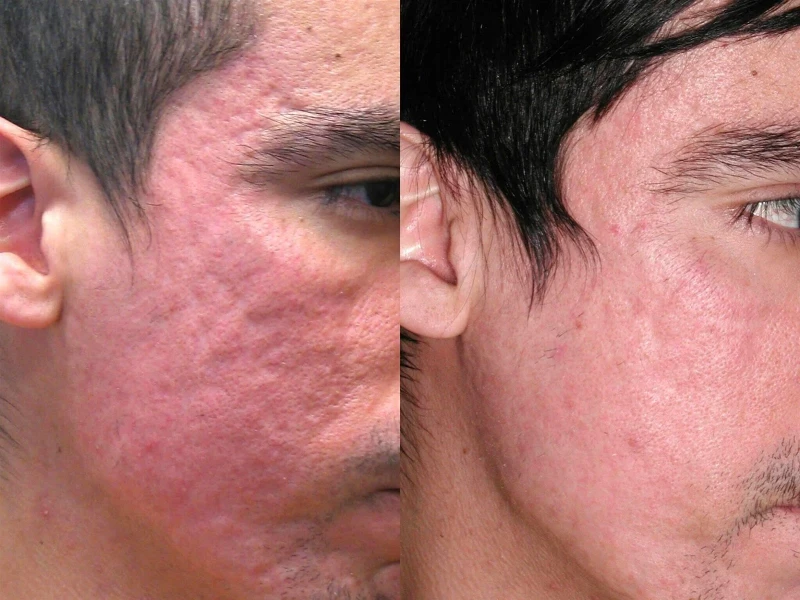
2. Depth of Penetration and Thermal Effect
The question of texture improvement is strongly related to how deeply a laser can affect the dermis.
CO2 Laser Depth
A fractional CO2 laser can reach deeper layers of the dermis (up to 2 mm depending on settings). This depth allows:
Strong dermal remodeling
Thickening of collagen fibers
Smoothing of deeper textural defects
Because texture issues (enlarged pores, acne scars, roughness) originate beneath the surface, deeper penetration is often necessary for visible improvements.
Erbium Laser Depth
Erbium:YAG typically penetrates 20–50 microns per pass, depending on fluence. While multiple passes can increase depth, the thermal effect is still much lighter than CO2, limiting collagen stimulation.
Conclusion on Depth
CO2 Laser → deeper, stronger remodeling
Erbium Laser → precise, shallow improvements
This difference plays a major role in final texture outcomes.
3. Texture Improvement: Which Performs Better?
Fine Lines and Mild Texture
Erbium lasers can perform very well in cases involving:
Mild roughness
Early fine lines
Light photodamage
Their precise ablation smooths the epidermis without aggressive heating.
Moderate to Severe Texture Problems
CO2 lasers consistently outperform Erbium lasers when treating:
Deep acne scars
Large pores
Rolling or boxcar scars
Deep wrinkles
Long-term roughness
Because CO2 lasers stimulate more collagen and reach stronger tissue remodeling layers, they offer better overall texture improvement, especially after multiple sessions.
Scientific Consensus
Dermatology studies repeatedly show:
CO2 lasers improve moderate-to-severe texture by 40–70%
ErbiumYAG lasers improve mild-to-moderate texture by 20–40%
Therefore, for substantial texture improvement, CO2 remains the gold standard.
4. Recovery Time and Downtime
CO2 Laser Healing
Redness: 5–10 days
Microcrusting: 3–7 days
Complete healing: 7–14 days
Full collagen remodeling: 2–3 months
Erbium Laser Healing
Redness: 2–4 days
Micropeeling: mild
Complete healing: 3–5 days
5. Comfort and Sensation During Treatment
CO2 resurfacing typically involves more heat. Clinics often use:
Topical anesthetic
Cooling devices
Post-treatment soothing agents
Erbium treatments are more comfortable due to reduced thermal spread. Some patients undergo it with minimal numbing.
6. Long-Term Texture Results
CO2 Laser
Strong collagen production
Long-lasting results (1–3 years depending on lifestyle)
More dramatic reduction in roughness and pore size
Visible improvement in depressed scars
Erbium Laser
Smoother surface appearance
Good for ongoing maintenance
Results typically last 6–12 months
7. Safety Considerations
CO2 Laser Risks
Higher risk of hyperpigmentation (especially Fitzpatrick IV–VI)
Requires skilled operation
Must follow strict aftercare and sun protection
Erbium Laser Risks
Generally safer for darker skin tones
Lower chance of prolonged erythema
Reduced thermal injury
8. Market Trend Insights and Industry Perspectives
Over the past five years, the market has shown a consistent shift:
CO2 lasers dominate the category of professional resurfacing for pronounced texture issues.
Fractional systems have increased safety, making CO2 resurfacing more accessible.
Hybrid lasers (CO2 + Er:YAG) are emerging in some markets but remain niche.
Clinics with strong acne-scar demand overwhelmingly choose CO2.
Data from global aesthetic equipment suppliers shows CO2 systems remain among the top five most-requested devices in resurfacing technology.
9. How NewAngie Fits Into the Global CO2 Laser Landscape
As one of the active manufacturers in the medical beauty equipment sector, NewAngie has gained recognition among international distributors and clinics for its 10600nm fractional CO2 laser systems, which are widely used for:
Acne scar revision
Texture smoothing
Skin tightening
Pigment correction
Stretch mark treatment
Why NewAngie's CO2 Fractional Systems Are Frequently Selected
Stable RF metal tube ensuring consistent output
Adjustable scanning patterns for complex texture correction
High-density fractional capability for treating deep scars
User-friendly interface suitable for both new and experienced practitioners
Strong global presence through exhibitions, distributor networks, and OEM/ODM production
Clinics often highlight the balance between performance, durability, and cost-efficiency, which allows them to offer premium resurfacing services without excessive equipment investment.
Industry feedback shows that NewAngie's CO2 systems are frequently chosen in markets where acne-scarring and texture treatments are high-demand categories.
10. Which Laser Should Clinics Choose?
Choose CO2 Laser If Your Clinic Focuses On:
Acne scar treatment
Large pores
Deep textural resurfacing
Anti-aging correction
Strong collagen remodeling
Patients who can accept downtime
Long-term visible improvements
Choose Erbium Laser If You Focus On:
Light resurfacing
Quick-recovery treatments
Maintenance programs
Patients seeking subtle enhancements
Mild fine lines and mild texture concerns
Combine Both If Possible
Some clinics choose to own both systems:
Erbium for lighter resurfacing
CO2 for core texture and scar procedures
This dual approach allows clinics to serve a wider range of patients.
11. Which Laser Gives Better Texture Improvement?
For patients and clinics seeking the strongest, most noticeable improvement in skin texture, the answer remains clear:
CO2 laser provides superior texture improvement compared to Erbium laser.
Its deeper thermal penetration, collagen stimulation, and ability to remodel scar tissue make it the more effective technology for:
Depressed acne scars
Pronounced roughness
Enlarged pores
Deep wrinkles
Long-term texture renewal
While Erbium lasers offer faster recovery and are excellent for lighter resurfacing, CO2 lasers deliver the transformative results that patients with significant texture concerns are looking for.
With brands like newangie continuing to supply advanced fractional CO2 systems globally, clinics today have access to reliable, high-performance equipment that can improve treatment outcomes and support long-term business growth.


