


Advances in Fractional CO₂ Laser Technology: How 10600nm Precision Is Redefining Scar Repair, Skin Resurfacing, and Clinical Outcomes
In recent years, fractional CO₂ laser technology has continued to play a central role in medical aesthetics and dermatology. Despite the emergence of newer energy-based devices, CO₂ lasers remain a benchmark for treating complex skin concerns such as acne scars, pigmentation disorders, surgical scars, stretch marks, and advanced skin aging. The reason lies not in marketing hype, but in the fundamental physics and biological response behind the 10600nm wavelength and its controlled thermal interaction with skin tissue.
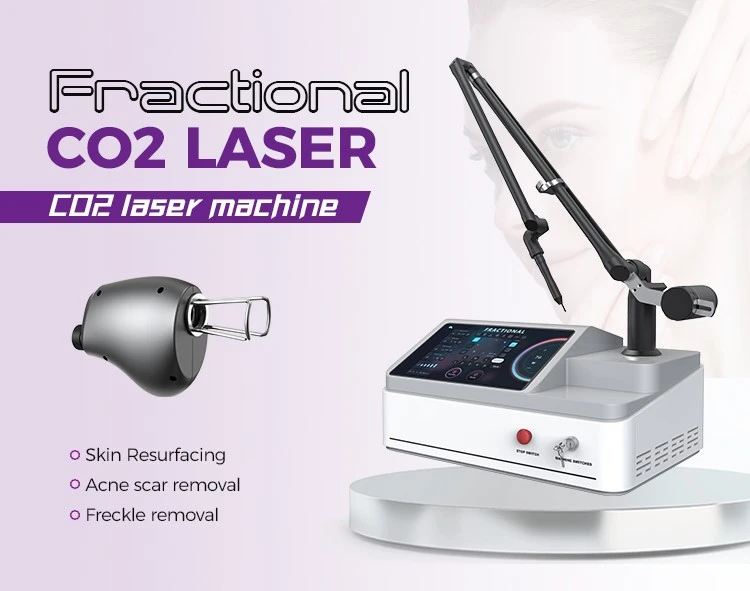
Understanding the 10600nm Wavelength: Why CO₂ Lasers Are Still Unique
The CO₂ laser operates at a wavelength of 10600nm, which belongs to the far-infrared spectrum. This wavelength is highly absorbed by water molecules, making it exceptionally effective for controlled tissue vaporization. Because human skin contains a high percentage of water, the CO₂ laser can precisely ablate targeted tissue layers while generating thermal stimulation in the surrounding dermis.
Unlike non-ablative lasers that rely mainly on heating, the CO₂ laser is classified as an ablative laser. This means it physically removes micro-columns of tissue, triggering a strong wound-healing response. The result is not only surface renewal but also deep collagen remodeling, which is essential for treating structural skin damage such as deep acne scars and stretch marks
Tissue Interaction and Depth Control
One of the defining features of CO₂ laser treatment is its predictable tissue interaction:
Ablation depth: approximately 0.1–0.2 mm, where superficial tissue is vaporized.
Thermal coagulation zone: around 0.5 mm, which promotes collagen contraction and regeneration.
Spot spacing: commonly 0.5 mm, allowing fractional coverage that balances efficacy and recovery.
This layered effect-ablation followed by thermal coagulation-is the foundation of CO₂ laser resurfacing. By adjusting power, pulse width, and dot spacing, clinicians can tailor treatments for superficial rejuvenation or deeper scar remodeling
Focal Spot and Energy Precision
Modern CO₂ laser systems typically offer a focal spot range of ±3 mm, ensuring consistent energy delivery across the treatment area. Power settings usually start from 40W, with pulse widths as short as 0.1 ms, enabling high peak energy per dot-often exceeding 4 mJ.
From a clinical perspective, the general principle is:
Higher power allows stronger tissue interaction.
Shorter pulse width reduces heat diffusion, improving precision and minimizing collateral damage.
This balance is especially important for scar treatments, where controlled depth and energy density determine outcomes and safety
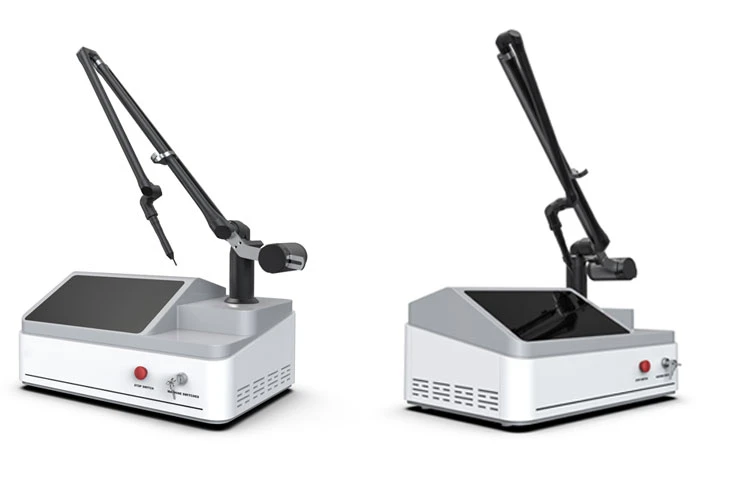
Key Clinical Indications
Fractional CO₂ lasers are widely used for a range of dermatological and aesthetic concerns, including:
1. Acne Scars and Depressed Scars
CO₂ lasers are considered one of the most effective tools for treating acne scars. By creating microthermal zones in scarred tissue, the laser stimulates collagen reorganization, gradually improving texture and depth.
Typical parameters for acne scars:
Power: around 20W
Pulse width: 0.5 ms
This configuration provides sufficient penetration to remodel fibrotic tissue without excessive surface damage
2. Acne Marks and Post-Inflammatory Pigmentation
While pigmentation itself is not the primary target of CO₂ lasers, fractional resurfacing improves epidermal turnover and enhances skin uniformity. This makes it useful for post-acne marks and uneven tone when used appropriately.
3. Surgical Scars and Trauma Scars
For thickened or irregular scars, CO₂ lasers help break down abnormal collagen bundles and encourage more organized regeneration. Multiple sessions may be required depending on scar age and depth.
4. Stretch Marks
Stretch marks represent dermal damage rather than superficial discoloration. The deep thermal stimulation generated by CO₂ lasers makes them suitable for improving texture and elasticity over time.
5. Skin Resurfacing and Brightening
For superficial skin renewal and tone improvement, CO₂ lasers can be used with lighter parameters:
Power: high power
Pulse width: 0.2–0.3 ms
Dot spacing: 1.0 mm
This approach focuses on epidermal renewal rather than deep remodeling, making it suitable for patients seeking skin brightening and texture refinement
Tattoo Removal and Special Applications
CO₂ lasers can also be used for certain tattoo removal cases, particularly when dealing with raised or fibrotic tattoo tissue. Unlike pigment-selective lasers, the CO₂ laser physically removes tissue, making it a secondary option in complex scenarios
Post-Treatment Skin Response and Recovery
A key concern for patients considering CO₂ laser treatment is downtime. Typical post-procedure responses include:
Redness: a natural inflammatory response that supports tissue repair.
Swelling: usually subsides within 2–3 hours.
Crusting: part of the normal healing process after ablative treatment.
Proper post-care is essential. Oil-based sunscreen is often recommended to protect the treated area while maintaining skin hydration. Once crusting has completely resolved, treatments such as hydra-dermabrasion or "aqua peeling" can be safely introduced to enhance skin recovery and clarity
Glass Tube vs. RF Tube CO₂ Lasers: A Technical Comparison
Glass Tube CO₂ Lasers
Glass tube systems are commonly used for broader, less precise treatments.
Key characteristics:
Suitable for coarse or extensive treatments
Average lifespan: ~1000 hours
Energy stability: approximately ±15%
These systems are often cost-effective and widely adopted, especially in entry-level or high-volume clinics
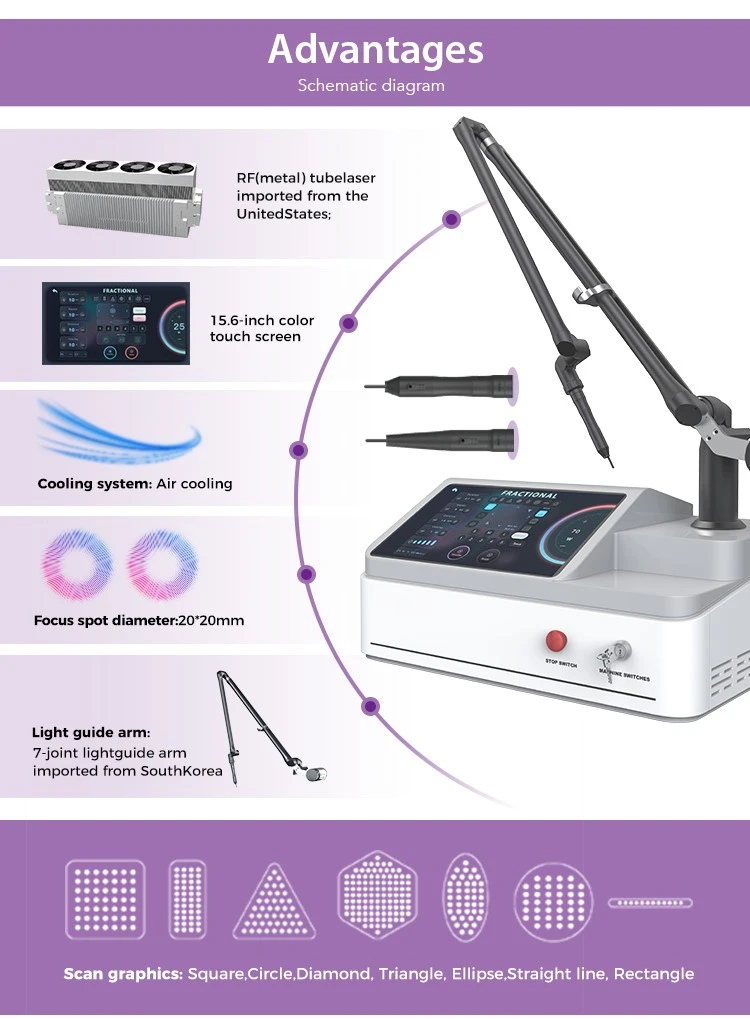
RF Tube CO₂ Lasers
RF tube technology represents a more advanced approach.
Key characteristics:
Designed for high-precision, refined treatments
Lifespan: up to 20,000 hours
Energy stability: ±5%, significantly more consistent
The improved stability and longevity of RF tubes make them ideal for clinics that prioritize consistency, detailed facial work, and long-term operational efficiency
Why CO₂ Laser Technology Continues to Evolve
Despite competition from non-ablative lasers, RF microneedling, and ultrasound-based devices, CO₂ lasers remain irreplaceable for certain indications. Their ability to combine tissue ablation with deep thermal stimulation offers results that are difficult to replicate with other technologies.
What has changed is not the relevance of CO₂ lasers, but their precision, safety, and customization. Modern systems allow clinicians to fine-tune parameters to match individual skin conditions, reducing risks while improving outcomes.
Fractional CO₂ laser technology represents a mature yet continuously evolving solution in medical aesthetics. With its 10600nm wavelength, controlled ablation depth, and powerful collagen-stimulating effects, it remains a gold standard for scar repair and skin resurfacing.
By understanding treatment parameters, appropriate indications, post-care management, and the differences between laser tube technologies, practitioners can maximize both safety and clinical results. As patient demand for effective, evidence-based treatments grows, CO₂ lasers are likely to remain a cornerstone of advanced dermatological care for years to come.


